
Generative AI has made it easier for brand owners to explore supplement ideas before approaching a manufacturer. Using it to compare ingredients, review research or draft an initial formula is resourceful, but it’s not a substitute for formal product development.
The limitations often become apparent when that digital formula enters manufacturing.
A formula that appears credible on screen may not account for Malaysian regulatory requirements, ingredient specifications, bulk density, tropical stability or commercial production constraints.
Our guide explores seven common gaps between AI-generated supplement formulations and commercially manufacturable products. It explains how professional supplement formulation in Malaysia can help address these gaps before detailed quotations and production planning begin.
Key Takeaways
- AI-generated formulas may overlook manufacturing constraints: A clinically relevant dosage may require more physical space than the intended capsule or sachet can accommodate.
- Classification influences formulation: Ingredient type, dosage form and proposed claims can affect the applicable product pathway in Malaysia.
- Tropical stability requires early consideration: Moisture-sensitive ingredients may cake, absorb humidity or affect product performance during storage.
- Ingredient suitability extends beyond names: Raw-material specifications, sourcing, processing and Halal documentation can all affect feasibility.
- AI is best suited to ideation: Formulation specialists are still required to translate the concept into a viable manufacturing specification.
The Role of AI in Early-Stage Supplement Ideation
Generative AI is increasingly being used across the nutraceutical and dietary supplement industry to support early-stage research, ingredient exploration and concept development.
For brand owners, it can help structure an initial formulation direction by summarising published research, identifying relevant ingredient categories and comparing how different ingredients may support the same functional objective.
This is particularly useful when the product concept is still being shaped and the intended function, target consumer or dosage format is known, but the technical formulation brief has not yet been defined.
Why Are Brand Owners Moving Beyond Standard Formulas?
Existing formulas can support a faster development route, but they offer less flexibility for brands seeking greater control over ingredients, dosage or product positioning.
Custom development offers greater scope for differentiation, particularly when a brand wants to establish a distinct ingredient profile, dosage strategy, or product concept rather than adopt an existing formulation.
AI can support this early stage by helping organise the concept before it enters formal R&D.
When deciding between custom OEM development and an existing formulation model, read the OEM vs ODM: Which Supplement Manufacturing Model Is Right for Your Brand? article to find out more.
How Does AI Support Early-Stage Formulation ?
Generative AI can summarise research, explain proposed mechanisms of action and identify potentially complementary ingredient categories.
It can also help structure a concept around a target function such as sleep support, joint mobility or general metabolic wellness.
These outputs remain conceptual. An AI-generated supplement formula can provide a useful formulation brief, but it is not yet a production-ready manufacturing specification.
Any studies, dosage references or ingredient claims surfaced by AI should also be checked against their original sources before they are used to inform formulation decisions.
The value of AI at this stage is not to replace professional formulation expertise, but to help brand owners develop a clearer, more structured starting point for the formulation process.
7 Manufacturing Constraints AI-Generated Formulas Often Miss
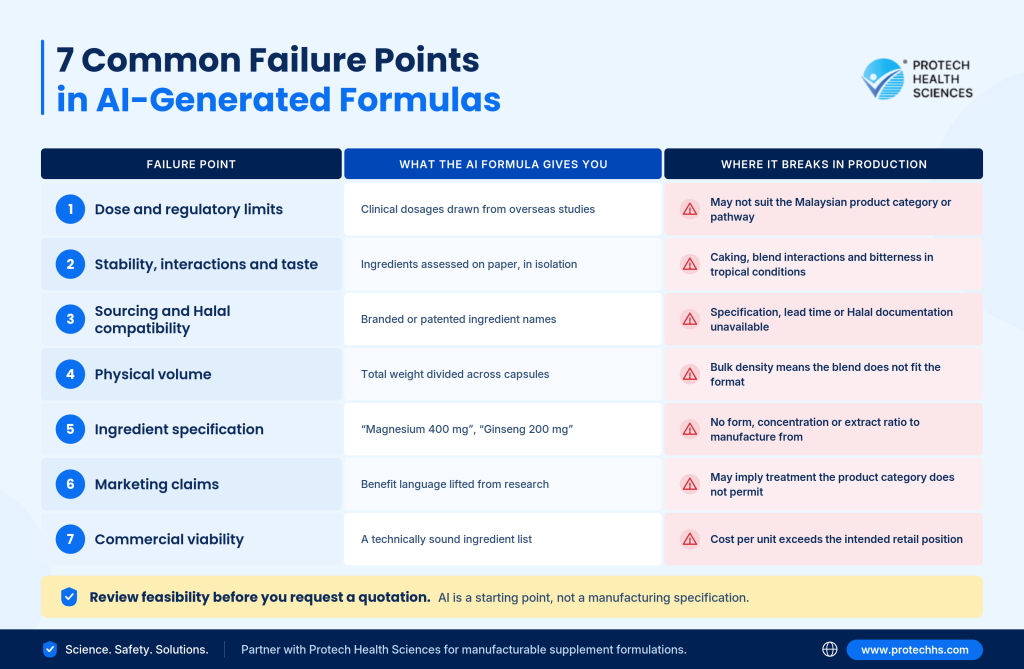
Before commercial production, a supplement formula must account for regulatory classification, raw-material specifications, physical volume, stability, permissible claims and commercial constraints.
This framework identifies where a concept that appears sound digitally can become difficult, costly or impractical to manufacture at scale.
These issues often emerge only after a formula is submitted for quotation. The manufacturer may then need to clarify dosages, replace ingredients, reconsider the dosage format or revise the concept before accurate costing can begin, extending the quotation process and delaying the project.
A feasibility review can identify these constraints before detailed costing begins.
1. Dose and Regulatory Limits: The Food-Drug Interphase Blind Spot
Generative AI draws from international research conducted under different regulatory systems.
AI-generated formulas may reproduce clinical dosages that are unsuitable for the intended Malaysian product category or regulatory pathway. The proposed dosage should also be checked against the original evidence rather than accepted from the AI output alone.
In Malaysia, factors such as ingredient composition, dosage form and intended product claims can affect how a supplement is classified. Foods, health supplements and natural products are subject to different regulatory requirements, which should be considered during the formulation process.
Key Considerations During Early Formulation:
-
- Product Category: Identify the appropriate product category based on the proposed ingredients, dosage form and intended claims. The NPRA Product Classification Guideline provides a useful reference for understanding these categories.
- Ingredient and Dosage Suitability: Review the proposed ingredients and dosage levels against the requirements of the intended product category. For NPRA-regulated products, the Drug Registration Guidance Document (DRGD) provides relevant guidance.
Considering these factors early allows formulation specialists to recommend suitable adjustments before the formula, claims and packaging direction are finalised. Where applicable, the relevant NPRA health supplement guidelines can also help guide product development and ensure that formulation decisions take regulatory requirements into account.
For a broader view of how regulatory requirements affect the overall development timeline, see How Long Does It Take to Launch a Supplement Brand in Malaysia? A Manufacturer’s Guide.
2. Tropical Stability: Can the Formula Withstand Malaysian Conditions?
Malaysia’s temperature and humidity can expose formulation weaknesses that may not be apparent during early concept development.
Packaging compatibility should also be considered during formulation development. Moisture-barrier packaging, appropriate sealing and suitable storage conditions can help protect sensitive ingredients.
The finished formulation and its proposed packaging should subsequently be evaluated through appropriate stability studies to support the intended shelf life.
Three areas usually require assessment:
- Moisture Sensitivity: Hygroscopic ingredients can absorb moisture from the surrounding environment, contributing to powder caking, reduced flowability or changes during storage.
- Ingredient Interactions: Materials that perform acceptably on their own may behave differently when blended, particularly where acidity, mineral content, moisture sensitivity or botanical extracts alter the characteristics of the finished formula.
- Taste and Sensory Profile: Botanical extracts may support the intended function but still introduce bitterness, astringency or strong aromas that require flavour systems, sweeteners or other supporting ingredients.
Stability, ingredient interactions and sensory performance therefore need to be evaluated as part of the formula rather than addressed only after the active ingredients have been finalised.
3. Raw-Material Sourcing and Halal Compatibility
An ingredient can be technically suitable but commercially impractical if the required specification is unavailable or cannot meet the intended manufacturing requirements.
AI-generated formulas may recommend specialised branded or patented ingredients without accounting for regional availability, supplier lead times or documentation requirements.
Before approving a raw material, the formulation team may need to confirm:
- Regional availability: Can the required ingredient specification be sourced reliably within the intended production timeline?
- Supplier documentation: Are the origin, manufacturing and technical documents sufficient for qualification?
- Halal suitability: Do the ingredient source, processing method, carriers and supporting documentation meet the intended Halal considerations?
Halal considerations should extend beyond the named active ingredients to include excipients, capsule-shell materials, processing aids, supplier documentation and applicable manufacturing requirements.
For a health supplement OEM in Malaysia, early raw-material qualification reduces the risk of replacing an ingredient after dosage, flavour and product positioning have already been established.
4. Is the Formula Compatible With the Intended Dosage Form?
AI can calculate ingredient weight, but weight alone does not determine whether a powder blend will fit into a capsule.
Different materials have different bulk densities. Two ingredients with the same weight may occupy substantially different volumes.
For example, a formula containing several grams of active ingredients cannot be assumed to fit into a two-capsule serving simply because the total dosage has been divided mathematically.
Actual capsule capacity depends on capsule size and the powder blend’s physical characteristics.
When the required volume exceeds the intended format, a formulation team may need to:
- Adjust ingredient quantities where clinically and commercially appropriate
- Use more concentrated extracts where suitable
- Increase the number of capsules per serving
- Consider another format such as a powder sachet or stick pack
The appropriate approach depends on the formulation, intended consumer experience and product positioning.
If the original dosage form is not practical for manufacturing, exploring alternative formats can help identify a more suitable option. Protech’s OEM health and beauty supplement manufacturing services provide an overview of available product formats and custom manufacturing support.
5. Preliminary AI-Generated Ingredient Description
Descriptions such as “magnesium 400 mg” or “ginseng 200 mg” are not complete manufacturing specifications.
The ingredient name alone does not specify the form, concentration or physical characteristics required for manufacturing.
Why the Ingredient Name Alone Is Not Enough
AI-generated specification | Manufacturing question |
Magnesium 400 mg | Which magnesium form is intended, and how much elemental magnesium does it provide? |
Ginseng 200 mg | Is this raw powder, a concentrated extract or a standardised extract? |
Botanical extract | What extraction ratio or active-constituent specification applies? |
Mineral ingredient | Which salt form and physical characteristics are required for the formulation? |
For mineral ingredients, the declared raw-material quantity must also be distinguished from the amount of elemental mineral supplied, as these values can affect dosage calculations, regulatory compliance and manufacturing feasibility.
These differences can affect constituent concentration, physical volume, formulation behaviour and cost.
During custom supplement formulation, broad AI-generated ingredient descriptions must be converted into defined raw-material specifications before manufacturing feasibility can be properly assessed.
Turn Your Product Idea into Reality
From formulation to packaging and regulatory support, partner with
experienced OEM specialists to turn your product
idea into a market-ready brand.
6. Are the Proposed Claims Appropriate for the Product?
AI-generated concepts often include suggested marketing claims based on research terminology.
Those claims still need to comply with applicable advertising and product-claim requirements for the finished product and its regulatory category.
Language drawn directly from clinical literature may imply treatment, prevention or other therapeutic outcomes that are not suitable for the intended product:
- Disease-risk-reduction claims: Certain disease-risk-reduction claims may be permitted for NPRA-regulated health supplements, subject to the applicable evidentiary and regulatory requirements.
Claims implying disease treatment, cure or prevention must be distinguished from permissible health supplement claims and assessed against the relevant product category.
- Nutritional and functional claims: Claims relating to nutrient content, physiological function or wellbeing must remain consistent with the formulation, supporting evidence and applicable Malaysian requirements.
Claims should therefore be considered during formulation development to keep product composition, positioning and regulatory direction aligned from the outset.
7. Is the Formula Commercially Viable to Produce?
A formula may be technically feasible but not economically viable to produce.
Key considerations include:
- Ingredient cost: Premium or specialised actives can significantly increase cost per unit.
- Supplier requirements: Some raw materials may involve minimum purchase quantities or longer lead times.
- Formulation complexity: Additional actives can increase sourcing, testing and production requirements.
- Target retail positioning: The finished cost still needs to support the intended sales channel and margin structure.
Value engineering helps determine which ingredients materially support the product proposition and which introduce disproportionate cost or manufacturing complexity.
MOQ represents only one component of the overall cost structure. What First-Time Supplement Brands in Malaysia Get Wrong About MOQ explains how formulation, format, sourcing and packaging can influence production minimums.
How AI and Formulation Engineering Complement Each Other
Brand owners can use AI to explore ingredients, organise research and establish an initial concept. Professional supplement formulation services can then assess how to adapt that concept for commercial manufacturing.
A feasibility review bridges concept logic and manufacturing requirements by assessing the proposed formula against regulatory, physical, sourcing, and commercial considerations.
How Do Formulation Specialists Refine an AI-Generated Formula?
The process generally involves four areas:
- Regulatory assessment
Review the proposed ingredients, dosage form and positioning against the intended Malaysian product pathway before significant development work begins.
- Ingredient specification
Translate broad ingredient descriptions into defined raw materials and replace unsuitable, unavailable or unnecessarily bulky options where required.
- Manufacturing and stability assessment
Evaluate powder behaviour, moisture sensitivity, physical volume and other characteristics that affect production and storage. - Sensory development
For powders, beverages and chewable formats, assess flavour, sweetness, acidity, colour and mouthfeel alongside the functional formulation.
Preparing for a Formula Feasibility Review
Before submitting an AI-generated formula, prepare:
- Proposed ingredient list: Include all intended active and supporting ingredients where known.
- Target dosage per serving: Provide the proposed amount for each ingredient if already determined.
- Preferred dosage form and packaging: Specify whether the product is intended as a capsule, tablet, powder or liquid, together with any preferred packaging format, such as bottles, sachets or stick packs.
- Intended product function: Explain the main consumer need or positioning the formula is intended to support.
- Target consumer group: Identify the intended audience where relevant.
- Preferred claims or positioning: Include any key messages the brand expects to communicate.
- Supporting studies or AI-generated references: Provide source material where available so the formulation team can review the basis of the proposed concept.
A more complete brief gives the formulation team greater context to identify potential regulatory, sourcing and manufacturing constraints before detailed costing begins.
From AI Concept to Manufacturable Supplement

An AI-generated formula can provide a useful starting point, but commercial production depends on whether the concept meets regulatory, sourcing, stability, dosage-format and cost requirements.
Once the concept has passed an initial feasibility assessment, development can progress to laboratory-scale prototyping and, where appropriate, pilot-scale manufacturing trials.
These stages allow the R&D team to evaluate sensory characteristics, powder behaviour, processing performance and other critical formulation attributes before commercial-scale production is confirmed.
The objective is to retain the strongest parts of the concept while adapting the product to actual manufacturing requirements.
As development progresses, consider quality-control and testing requirements based on the product category, ingredients, and intended market.
These may include product specifications, analytical testing, stability assessment and supporting documentation before commercial production.
Contact Protech’s formulation specialists for available product formats and custom formulation support.
Turn Your Product Idea into Reality
From formulation to packaging and regulatory support, partner with
experienced OEM specialists to turn your product
idea into a market-ready brand.
Frequently Asked Questions (FAQs)
The entire concept does not necessarily need to be discarded.
A formulation specialist can identify which ingredient, dosage, raw-material specification or delivery format is creating the constraint and assess whether that element can be replaced, adjusted or reformulated while retaining the intended product direction.
The specific AI platform is generally less important than the information it produced.
The formulation team will primarily need to understand the proposed ingredients, dosages, intended product format and rationale behind the concept. If the AI output includes supporting studies or source references, providing those can also help the team evaluate the basis of the proposed formulation.
An early-stage ingredient list can still provide a useful starting point for a formulation discussion.
Reviewing the concept before every dosage has been fixed may provide greater flexibility to assess ingredient compatibility, product format, regulatory considerations and commercial feasibility.
Formula ownership, exclusivity and permitted use should be confirmed in the applicable development and manufacturing agreement.
Brand owners should establish these terms before development begins, particularly when the project involves a proprietary formulation.
Potentially, but one formulation should not automatically meet the requirements of every market.
Ingredient requirements, product classification, claims and labelling rules can differ between countries. Regional expansion should therefore be considered during formulation planning if multiple ASEAN markets are part of the commercial strategy.
Yes. Protech provides product registration and Halal support as part of its supplement development services.
The applicable process will depend on the final product category, formulation and intended market.