

How long does it take to launch a supplement brand in Malaysia? A fully compliant launch takes 8 to 12 months from concept to first legal sale, not the 90 days many manufacturers promise.
Malaysia’s health supplement market is surging as consumers seek localised health solutions. However, many ambitious founders find their capital tied up and launches delayed because they believed a common industry myth: you can bring a supplement to market in three months.
If you’re planning to launch a supplement brand in Malaysia, understand that manufacturing speed and regulatory compliance operate on different timelines.
Before planning your launch, it helps to understand what classifies as a supplement in Malaysia.
A supplement is any product taken orally to supplement the diet, providing nutrients or bioactive compounds such as vitamins, minerals, herbs, amino acids, or enzymes.
Malaysia regulates supplements under two distinct categories:
- Health supplements (MAL products): Regulated by NPRA, requiring a Marketing Authorisation for Listing (MAL) number before legal sale
- Food or dietary supplements: Regulated under the food category with a faster registration timeline, but prohibiting health benefit claims entirely
This guide covers health supplements, the category applicable to most branded supplement launches.
There are two main routes to market in Malaysia: private label (rebranding existing formulas, 4-8 weeks) and custom formulation via OEM or ODM (creating your own unique product, 8-12 months).
This guide focuses on custom formulation; the path that gives you true product differentiation and brand equity, but we’ll address private label timelines for context.
Key Takeaways:
- Realistic timeline is a full year: From product concept to legal market launch, expect 12 months, not the misleading 90-day claims from production-focused OEMs
- NPRA approval is mandatory: Expect 6 to 9 months of regulatory review before receiving your MAL number
- The “Dead Zone” is productive: Use the 6-month regulatory wait to build brand identity, launch waitlist campaigns, and create marketing momentum for day-one conversion
- Three critical stages: Formulation and sampling (Month 1-3), regulatory queue (Month 4-9), and manufacturing and launch (Month 10-12)
- Soft launches are illegal: Selling unregistered supplements before MAL approval results in MOH fines, product seizures, and permanent bans from e-commerce platforms such as TikTok Shop
The 90-Day Myth vs. The 12-Month Reality
Many manufacturers advertise 90-day timelines for supplement launches. What they’re referring to is production time, the manufacturing process itself. However, legal market entry in Malaysia requires regulatory approval first, which operates on a different timeline.
The Difference Between Production and Compliance
OEM factories can blend, encapsulate, and bottle your formula in 3 months. However, legal market entry requires approval from the National Pharmaceutical Regulatory Agency (NPRA) first. The distinction is crucial as production readiness and market readiness are not the same.
Founders often spend their entire marketing budget anticipating a 3-month launch, only to hit a regulatory wall. The Control of Drugs and Cosmetics Regulations 1984 mandate pre-market approval for all health supplements.
The Hidden Risk of "Soft Launches"
Some entrepreneurs may attempt to sell unregistered products whilst “waiting” for a MAL number. However, this act is illegal.
E-commerce platforms like TikTok Shop and Shopee automatically scrub unregistered health products, whilst MOH actively conducts raids on non-compliant sellers. Penalties include heavy fines, product seizures, and permanent platform bans.
The Complete Stage-by-Stage Timeline: From Formulation to First Sale
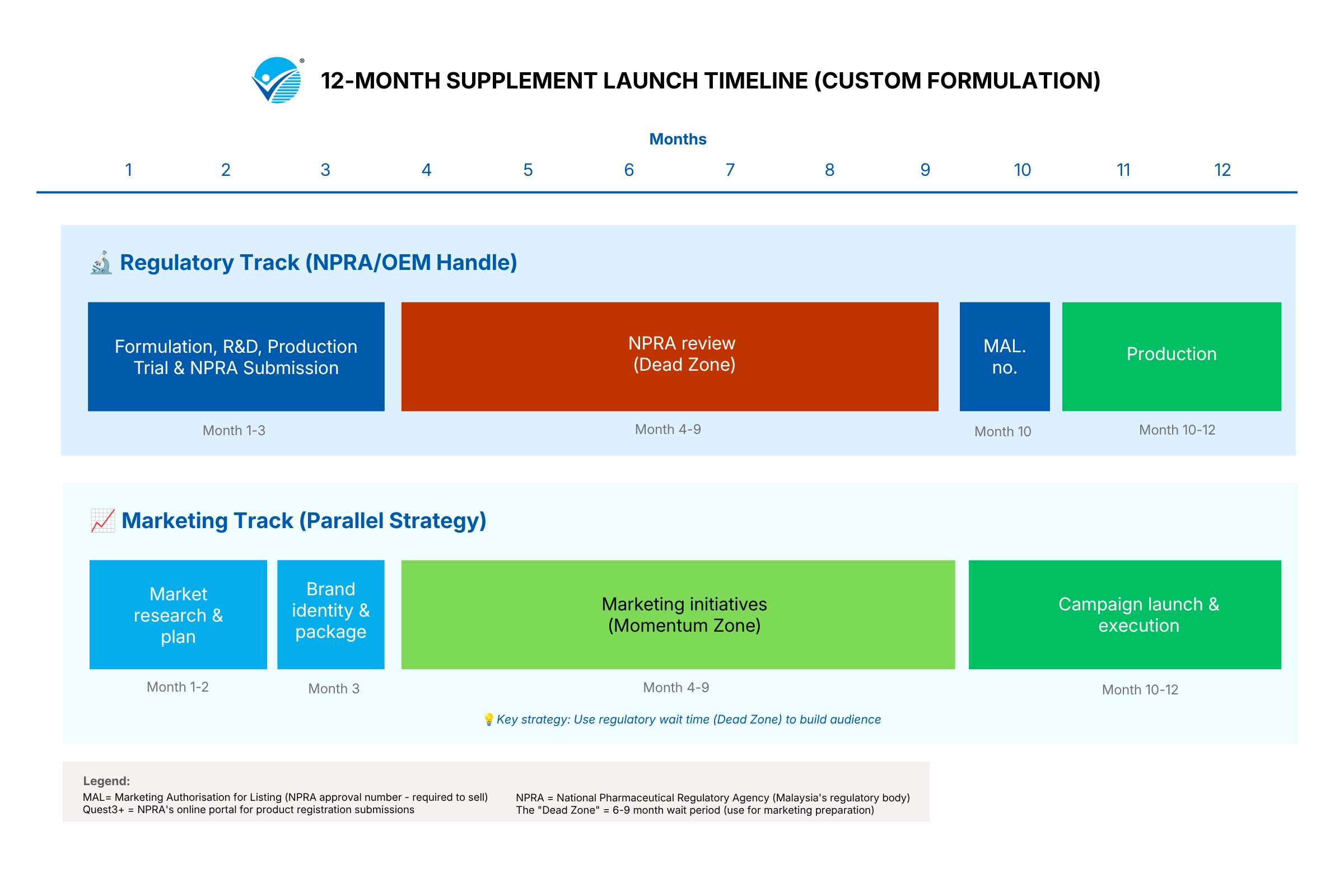
Stage 1 (Month 1–3): Preparation & Formulation
In the first three months, you will finalise your product concept, consult with an OEM to create a formulation brief, and conduct iterative research and development (R&D) until you approve the final “Golden Sample.”
This stage moves quickly compared to regulatory approval, but decisions made here determine your entire timeline. Choosing the wrong format or ingredient combination can add months to your NPRA review.
Month 1: Product Concept & Format Decision
Decide your niche (such as gut health, skin brightening, or joint support) and the delivery format that will carry your active ingredients to market.
Your format dictates your regulatory path. A botanical beverage sachet might fall under the product classification, whilst a capsule containing active ingredients will always require NPRA registration as a health supplement.
Choosing novel or highly specific active ingredients increases NPRA scrutiny and timeline.
Key decisions to make:
- Target health benefit and primary ingredient(s)
- Delivery format: capsules, sachets, powders, beverages or gummies
- Preliminary understanding of whether your product falls under the Food or Health Supplement classification
Month 1–2: OEM Consultation & Formulation Brief
Translate your marketing vision into a technical brief and get initial cost estimations.
During OEM consultation, you’ll work with formulators to balance ingredient efficacy with commercial viability. A premium collagen supplement with marine peptides will cost significantly more per unit than a basic Vitamin C tablet, and your target audience must be willing to pay the resulting price point.
Your OEM should provide:
- Formulation feasibility assessment
- Initial cost-per-unit estimates based on MOQ (Minimum Order Quantity)
- Regulatory category confirmation (Food vs Health Supplement)
- Timeline expectations for sample development
Month 2–3: Sample Development & Approval
The R&D phase is where your product comes to life through our product development process. You’ll receive lab samples, test them for taste and texture, and iterate until you lock in the “Golden Sample,” the final approved formulation for regulatory submission.
Critical caveat: Every change to flavour or ingredient ratio resets the R&D clock. A founder who changes their mind three times about sweetness levels can easily add 4 to 6 weeks to this stage.
Once the Golden Sample is approved, this exact formulation is what will be registered with NPRA. Any subsequent formula changes after registration will require a new submission and additional fees.
Month 3: Production Trial, Quest3+ Setup & NPRA Submission
Before submitting to NPRA, your OEM conducts a production trial (pilot batch) to verify the formula performs at manufacturing scale. This pilot batch confirms production viability before a full mass-production commitment.
To submit your product for NPRA approval, you must register your SSM company on the NPRA portal (Quest3+) as the Product Registration Holder (PRH). Our product registration services guide you through this critical phase.
This step requires precise documentation:
- SSM registration documents
- Digital certificates for Quest3+ portal access
- Product dossier (formulation details, manufacturing process, quality control procedures)
- Stability study protocol
- Certificate of Analysis (CoA) for raw materials
- Proof of GMP compliance from your OEM
If your documentation is not perfectly aligned, the application will be rejected before it even begins.
Stage 2 (Months 4–9): The Regulatory Queue
Once your NPRA application is submitted, your product enters the regulatory queue. This 6- month period is entirely out of your OEM’s hands and rests with government authorities.
Month 4–9: The “Dead Zone” (NPRA review)
This is the longest and most frustrating phase for founders: the mandatory wait.
Importance: This mandatory wait is not bureaucratic red tape. It is a compliance safeguard that ensures every product sold in Malaysia meets the standards set by the Control of Drugs and Cosmetics Regulations 1984.
During this period:
- NPRA reviewers assess your dossier for regulatory compliance
- Any queries from NPRA can pause the timeline until you respond
Most founders make the mistake of treating this as “dead time.” We’ll address how to use this productively in the Parallel Path Strategy section.
From Month 4: Halal JAKIM Certification (Concurrent with NPRA Review)
Navigating the Halal compliance layer is essential for the Malaysian market. Begin your Halal application alongside your NPRA submission; if your OEM is already JAKIM-certified, the facility is covered, but your specific product still requires an audit.
Importance: In Malaysia, a Halal logo is arguably a stronger driver of conversion than the brand name itself. Muslim consumers who represent the majority of the Malaysian market will not purchase a supplement without Halal certification, regardless of efficacy claims.
Caveat: Whilst Halal certification can run concurrently with the NPRA review, documentation backlogs at the Department of Islamic Development Malaysia (JAKIM) can sometimes add months to the timeline. Plan accordingly.
Stage 3 (Months 10–12): Manufacturing & Market Launch
Once NPRA issues your MAL number, you can legally sell your product in Malaysia. However, critical steps remain before your first sale.
Month 10–11: Mass Production, Stability Testing & Packaging
With the MAL number secured, your OEM purchases raw materials in bulk, runs the mass-production line, and applies compliant labelling.
Your labelling must perfectly match what was approved by NPRA in Stage 2. This includes:
- MAL number prominently displayed
- Ingredient list in the exact order and terminology submitted
- Dosage instructions as approved
- Health claims (if any) exactly as registered
- Storage instructions
- Batch number and expiry date
Any deviation from the approved label can result in fines or product seizure.
Month 12: Market Launch & First Sale
With production complete and compliant labelling applied, your product is legally cleared for market. Your launch activation strategy is covered in the Parallel Path section below.
Turn Your Product Idea into Reality
From formulation to packaging and regulatory support, partner with
experienced OEM specialists to turn your product
idea into a market-ready brand.
The Parallel Path Strategy: Marketing for Momentum

The biggest mistake new brand owners make is pausing their business during the 6-month NPRA review. Savvy entrepreneurs use this “Dead Zone” to build anticipation and generate revenue on day one of launch.
Months 3–4: Brand Identity & E-Commerce Infrastructure
Don’t wait for regulatory approval to build your brand. Use this time to:
Begin your packaging design process: Once your formula is confirmed and ready to submit to NPRA, work with our packaging design team to develop your visual concepts (brand colours, logo placement, and identity). The packaging design and formula must be submitted together to NPRA for screening and approval. Any required amendments identified during the evaluation process will need to be incorporated before the packaging can be finalised for production.
Set up your e-commerce infrastructure: Build your Shopify store, configure payment gateways (iPay88, Billplz), set up abandoned cart sequences, and prepare your shipping logistics. TikTok Shop and Shopee applications can take weeks to approve, so start the process now.
Create your brand story: Write your About page, founder story, and mission statement. Develop your brand voice and content pillars for social media.
Months 4–6: Influencer Seeding & Educational Content
You cannot sell the product yet, but you can sell the problem.
Start creating educational content about the health issue your product solves:
- If you’re launching a gut health supplement, create Instagram Reels about digestive wellness tips
- If you’re launching a collagen product, share evidence-based content about skin ageing
- Interview dermatologists, nutritionists, or wellness experts in your niche
Identify and onboard your affiliate network: Reach out to micro-influencers (5,000 to 50,000 followers) in the health and wellness space. Offer them early access to your product once approved in exchange for authentic reviews and promotion.
Months 7–8: The Waitlist Campaign
Tease the upcoming product. Run lead-generation ads to build a WhatsApp or email waitlist.
Proof point: Founders who build a waitlist during the NPRA queue routinely clear 30% of their initial inventory in the first week of launch. Your waitlist becomes your launch-day conversion engine.
Campaign ideas:
- “Coming Soon” landing page with countdown timer
- Behind-the-scenes content showing your product development journey
- Early-bird discount offers for waitlist subscribers
- Instagram Stories polls asking followers what flavours they’d prefer
Vital compliance note: You can generate interest and build a waitlist, but you cannot take pre-orders or accept payment until your MAL number is issued.
Month 9: Pre-Launch Preparation
With MAL approval approaching, shift focus from audience building to launch readiness:
- Brief your influencer network on launch date and campaign mechanics
- Finalise e-commerce product listings (pending MAL number)
- Prepare launch-day email and WhatsApp broadcast sequences
- Confirm logistics partners and fulfilment readiness
By Month 9, your brand is audience-ready. When your MAL number arrives at Month 10, everything you built during the Dead Zone activates, converting your waitlist into day-one customers.
Month 10–12: Launch Activation
With production complete, activate everything you built during the Dead Zone:
- Launch on TikTok Shop, Shopee, and Lazada
- Approach retail distributors and pharmacies
- Execute paid advertising with approved health claims
- Release influencer content to your pre-warmed audience
3 Aspects You Must Prepare Before Calling an OEM

Lorem ipsum dolor sit amet, consectetur adipiscing elit. Ut elit tellus, luctus nec ullamcorper mattis, pulvinar dapibus leo.
Ensure you have these fundamentals in place when contacting an OEM:
1. Your SSM Registration
You must have a registered Malaysian company. You cannot hold a MAL number as an individual.
If you’re operating as a sole proprietor or haven’t registered your business yet, do this first. The NPRA application requires your SSM registration number and official company documentation.
2. Capital Realities
Have funds set aside not just for Minimum Order Quantities (MOQs), but for regulatory and compliance fees that many first-time founders overlook.
The timeline for launching a supplement brand is directly tied to having sufficient capital to sustain your business through the regulatory queue.
Undercapitalisation is one of the primary reasons supplement launches stall halfway through the NPRA approval process.
3. Audience Demographics
Know exactly who you are selling to. Formulating a premium RM150 supplement for an audience that expects RM30 products will fail, regardless of how fast you launch.
Ask yourself:
- What is my target customer’s monthly household income?
- What price point are they accustomed to paying for supplements?
- Are they buying from pharmacies, e-commerce platforms, or aesthetic clinics?
- What health claims will resonate most with them?
Your formulation, packaging, and pricing must align with your audience’s expectations and purchasing power.
Not sure where to start or need help validating your product concept? Protech offers consulting services to guide you through the strategic planning phase—from regulatory category assessment to formulation feasibility and market positioning.
How to Successfully Navigate Your Supplement Launch Timeline
Launching a supplement brand in Malaysia is not a 90-day sprint but a strategic deployment. The difference between brands that fail and those that dominate the market is having a manufacturing partner who guides you through the regulatory maze rather than hiding it from you.
Protech Health Sciences bridges the gap between your vision and regulatory compliance. We handle the science and the paperwork, so you can focus on building a brand that lasts.
Why Choose Protech Health Sciences:
- Over 20 years of proven expertise: Industry in health and beauty OEM manufacturing
- Complete regulatory support : NPRA registration, Halal certification, and trademark assistance
- Formula exclusivity: A strict one formula per customer policy protects your market position
- One-team process: Seamless R&D to delivery under a single point of contact
- Science-backed formulations: High-efficacy products driven by research and market trends
- Export-ready production: GMP, HACCP and MeSTI certified with Halal standards for global markets
Ready to stop guessing your launch timeline and start planning your market entry?
Contact Protech Health Sciences today to speak with our formulation and regulatory experts.
Turn Your Product Idea into Reality
From formulation to packaging and regulatory support, partner with
experienced OEM specialists to turn your product
idea into a market-ready brand.
Frequently Asked Questions (FAQs)
NPRA review takes approximately 6 months once your application enters the queue, with MAL approval typically received around Month 10 of your launch timeline. Processing time may vary depending on the formulation's complexity and the completeness of the documentation.
Yes, registering a product as a Food or Botanical Beverage is significantly faster than registering with the NPRA. However, you are strictly prohibited from making any medical or health claims on your packaging or marketing materials.
If your product contains active ingredients intended to improve health outcomes (immune support, joint health, skin brightening), it will be classified as a health supplement and require a MAL number—regardless of its physical format.
If you partner with a reputable OEM like Protech, formulations are pre-screened against NPRA-banned substance lists before submission.
If a rejection occurs due to regulatory updates, a reputable OEM such as Protech Health will adjust the formulation and resubmit without charging you for a completely new R&D process.
Always clarify this in your contract before committing to an OEM.
No, you do not need a manufacturing licence. As the brand owner, you will be registered as the Product Registration Holder (PRH), whilst the OEM is listed as the licensed manufacturer on your Quest3+ application.
Your OEM's GMP certification and manufacturing licence cover the production process. Your responsibilities are product registration and brand compliance.
No. Whether you sell on TikTok Shop or exclusively through professional aesthetic clinics, any product intended for ingestion for health benefits must have a valid MAL number.
The distribution channel does not change the regulatory requirement. Aesthetic clinics are subject to the same MOH enforcement as e-commerce sellers.


2 Responses