
First-time supplement founders in Malaysia consistently make the same MOQ mistake: looking for the lowest possible MOQ.
That instinct, whilst understandable, can lead directly to crushed margins, dead stock, and stalled launches.
Minimum Order Quantity (MOQ) is the minimum batch size a manufacturer needs to produce your supplement efficiently and consistently.
In Malaysian supplement manufacturing, MOQ is shaped by product format, formulation type, packaging requirements, raw material sourcing, product classification, and production setup.
Founders who treat MOQ as a proxy for risk tolerance make one of the most common and costly errors in the market.
This article explains how MOQ works in Malaysian supplement manufacturing, what drives it by format, and how your MOQ decision affects cost per unit, regulatory path, and capital commitment.
Key Takeaways:
- MOQ is a manufacturing constraint: Your product format sets the minimum batch size.
- Lower MOQ means higher per-unit costs: Ultra-small batches can inflate per-unit costs and erode margins.
- Your first order should not be your maximum order: Over-ordering traps capital you may need for reformulation or relaunch.
- OEM and ODM carry different MOQ structures: Each model sets different entry thresholds and capital commitments.
- Format choice sets your regulatory path and MOQ ceiling: Capsules route through NPRA; powders route through product classification.
5 MOQ myths that cost Malaysian founders the most
In Malaysian supplement manufacturing, your product format determines your MOQ ceiling more than any other variable.
1. "MOQ is a fixed, non-negotiable number set by the factory"
How MOQ is actually set: MOQ is determined by the physical mechanics of your product format.
A capsule, powder sachet, liquid, gummy, jelly strip, or functional food does not carry the same production setup. Each format requires different machinery, handling, packaging, and quality control steps.
Capsule lines can switch between batches with relatively lower material waste. Sachet-packing machines may require longer setup time because of film rolls, sealing checks, and packaging calibration.
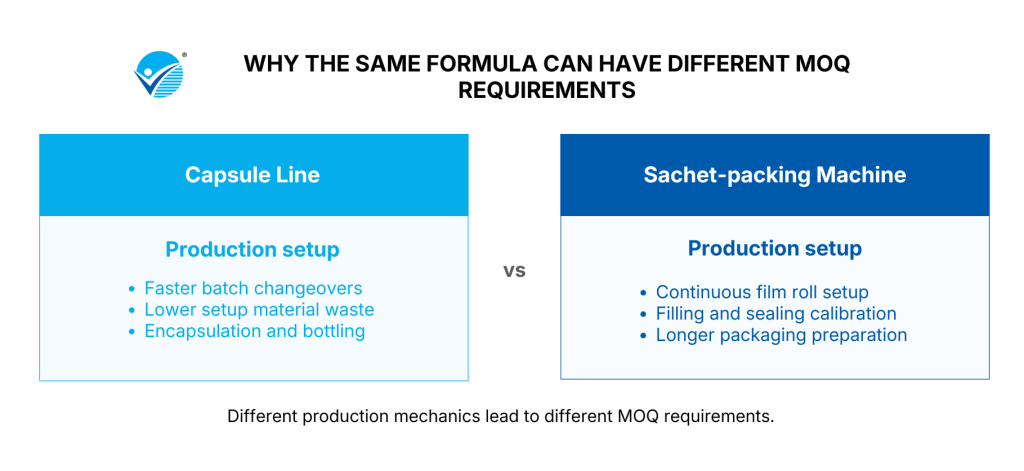
Custom formulations push MOQ higher still because the manufacturer needs to source raw materials, test the formula, and prepare a viable production run.
Regarding online MOQ figures: MOQ ranges quoted online, especially on global supplier platforms, rarely reflect the reality of Malaysian OEM and ODM operations. Always request a product-specific assessment before treating any figure as final.
In practice: MOQ is not one fixed number. It changes according to format, formulation route, packaging, and production requirements.
Not sure what entry MOQ makes sense for your specific product concept? Protech’s OEM consulting services include a free category assessment that maps your formulation idea to a realistic minimum batch size before any commitment is made.
Turn Your Product Idea into Reality
From formulation to packaging and regulatory support, partner with
experienced OEM specialists to turn your product
idea into a market-ready brand.
2. "A lower MOQ always means lower risk for my startup"
What low MOQ costs you: MOQ directly affects supplement cost per unit in Malaysia.
A very low MOQ may reduce your upfront spend, but it can also destroy your margin before you launch.
Factories do not remove their setup costs just because the batch is smaller. Machine calibration, cleaning protocols, operator time, and raw material handling still need to happen.
The most misunderstood MOQ dynamic in Malaysia: factory setup costs stay fixed regardless of batch size.
Fixed per-batch costs include:
- Machine calibration
- Cleaning protocols
- Operator time
- Raw material handling
- Packaging setup
- Quality checks
Spread those same costs across a smaller batch, and each unit absorbs more cost.
If your retail price is already fixed by market expectations, your margin may be gone before you spend a single Ringgit on marketing.
In practice: Low MOQ is only useful if the per-unit cost still leaves room for profit.
3. "My first order should be my maximum MOQ to save on per-unit cost"
The over-ordering trap: Over-ordering your first batch ties up capital in stock that may need reformulation.
The logic seems sound: larger batches usually reduce per-unit costs.
The risk: Early market feedback often triggers formula changes, flavour adjustments, packaging updates, or format rethinks.
If your first batch is too large and the product needs changing, you are stuck with stock that no longer fits the market.
You cannot reformulate whilst sitting on unsold inventory.
A first batch should be large enough to launch properly, but not so large that it traps the cash you need for improvement, marketing, or reorder planning.
In practice: Your first MOQ should support market validation, not just cheaper production.
4. "MOQ is the same whether I choose OEM or ODM "
How the two models differ: OEM and ODM carry different MOQ structures because the work behind each model is different.
- ODM (Original Design Manufacturer) uses the manufacturer’s existing, proven formula as the base. Because the formula already exists, there is less new formulation work to recover.
- OEM (Original Equipment Manufacturer) involves custom formulation from scratch. The manufacturer needs to account for R&D, raw material sourcing, sample development, testing, and production planning.
That is why OEM usually carries a higher MOQ structure than ODM.
ODM vs OEM: MOQ Structure at a Glance
Route | Formula approach | MOQ implication |
ODM | Proven formula with your branding | Lower development overhead |
OEM | Custom formula built for your brand | Higher R&D and testing commitment |
In practice: MOQ is not the same for OEM and ODM because the development work is not the same.
Need help choosing between OEM and ODM? See our OEM and ODM supplement manufacturing guide for a full decision matrix breakdown.
5. "I can’t afford OEM because the MOQ is too high"
The comparison problem: Many founders self-disqualify before they even enquire.
They compare local manufacturing options against global MOQ figures, overseas supplier listings, or generic startup advice that does not reflect Malaysian supplement manufacturing.
That comparison can be misleading.
MOQ depends on:
- Product format
- Formulation complexity
- Ingredient availability
- Packaging type
- Manufacturer capability
A simple capsule concept does not carry the same MOQ logic as a complex powder sachet, functional drink, gummy, or custom active formula.
Finding a realistic MOQ supplement Malaysia pathway means speaking to a local manufacturer who can assess your product concept, not guessing from global figures.
In practice: Do not rule out OEM before asking for a product-specific MOQ assessment.
How Product Format Affects MOQ in Malaysia

MOQ varies by product format. Your choice of format sets the minimum batch size.
Format-Specific MOQ Drivers in Supplement Manufacturing
Supplement format | Key MOQ driver |
Capsules / Tablets | Encapsulation machines require a minimum powder volume for accurate blending and dosing. |
Powder sachets | Sachet film rolls require minimum print runs, while filling and heat-sealing equipment must be calibrated before production. |
Liquids / Syrups | Bottle-filling and sterilisation lines require substantial setup time, making very small batches less practical. |
Gummies / Soft chews | Custom moulds require minimum batch volumes, and each flavour or colour variant may require a separate production run. |
Jelly / Gel strips | Specialised pasteurisation, filling and heat-sealing configurations increase production setup requirements. |
Note: Actual MOQs vary by manufacturer, formulation complexity, packaging specification, and current production requirements. Always confirm directly before budgeting.
The format that looks easiest to market may not be the easiest to manufacture at a small batch size.
Sachets, for example, may look convenient for sampling, but packaging setup can raise MOQ. Capsules may look simpler, but the final MOQ still depends on formula, dosage, bottle size, and product classification.
How MOQ Affects Supplement Cost Per Unit in Malaysia
Your MOQ decision directly affects your per-unit manufacturing cost.
Smaller batches spread the same factory setup cost across fewer units. That makes each unit more expensive to produce.
This is why the lowest batch quantity is not always the lowest-risk business decision.
A proper MOQ discussion should include:
- Manufacturing cost per unit
- Packaging cost
- Product classification cost
- Label and design cost
- Testing requirements
- Marketing budget
One cost founders consistently underestimate: packaging MOQs can run separately from manufacturing MOQs.
Custom labels, printed cartons, sachet films, pouches, or special packaging materials may each carry separate minimum requirements.
Your real capital commitment is not just the production MOQ. It is the combined cost of manufacturing, packaging, compliance, and launch preparation.
Need the full startup budget picture? For a full breakdown of every cost component, see our detailed budget guide.
Not sure how your MOQ choice maps to your startup budget? Protech’s product registration services team can walk you through both the manufacturing cost structure and the regulatory pathway before you commit to a production plan.
Malaysian Regulatory Pathways: How Format Choice Sets Your MOQ Ceiling
Your product format influences which regulatory path your product may fall under.
That decision can affect documentation, timeline, packaging, product claims, testing, and production planning.
Regulatory pathway comparison table: NPRA vs Product Classification
Format direction | Possible regulatory path | MOQ implication |
Capsules / tablets / softgels | Lower packaging complexity, but stricter supplement registration requirements | |
Powders / sachets / functional foods | Higher packaging considerations, depending on format and presentation |
Founders sometimes choose a format based only on trend or market appeal. That can create problems later if the product classification affects claims, packaging, or launch timeline.
The better approach is to review format, formula, and product classification before committing to MOQ.
In practice: Format choice affects more than production. It can also influence your regulatory path and MOQ ceiling.
For a full breakdown of the regulatory timeline, registration requirements, and what to prepare before approaching an OEM, see our guide to how long it takes to launch a supplement brand in Malaysia.
Find the Right MOQ for Your Brand with Protech Health Sciences
Choose your product format, understand your regulatory path, and work with Protech Health Sciences to size your first batch around real unit economics.
Protech helps first-time founders and growing supplement brands assess MOQ based on product format, formulation route, packaging requirements, product classification, and launch budget.
Why Choose Protech Health Sciences:
- Over 20 years of proven expertise: Industry-tested experience working with first-time founders, established supplement brands, and health distributors across Malaysia and international markets
- OEM and ODM support: Choose between custom formulation and proven formula routes based on your product goals
- Complete regulatory support: JAKIM Halal certification, NPRA registration, and MeSTI pathway guidance under a single point of contact
- Formula exclusivity: A strict one-formula-per-customer policy that protects your market position
- GMP-certified, export-ready production: HACCP certified with Halal standards for both local and global markets
- Science-backed formulations: Product development guided by in-house R&D and current market trend data
Ready to find out what MOQ makes sense for your product?
Contact Protech Health Sciences today to speak with our formulation and regulatory team.
Turn Your Product Idea into Reality
From formulation to packaging and regulatory support, partner with
experienced OEM specialists to turn your product
idea into a market-ready brand.
Frequently Asked Questions (FAQs)
Yes. You can request an early MOQ estimate based on your product format, formulation direction, packaging preference, and launch budget.
The estimate may change once the final formula, ingredients, product classification, and packaging are confirmed.
Often, yes. ODM usually has less development work because the formula already exists.
OEM usually requires custom formulation, ingredient sourcing, sample development, and testing. That is why MOQ structures are often higher for OEM.
Yes. Packaging can create its own MOQ.
Sachets, printed cartons, custom labels, pouches, and special packaging materials may carry separate minimum requirements from production.
Each flavour is usually treated as a separate production run.
That means each flavour may carry its own MOQ because blending, flavouring, cleaning, and recalibration need to happen separately.
No. Shelf life is determined by ingredient stability and packaging performance, not batch size.
The risk is commercial: if your batch sells too slowly, you have less time to clear stock before expiry.
Prepare your product idea, target customer, preferred format, key ingredients, packaging direction, sales channel, launch timeline, and budget range.
The more specific your concept, the more useful the MOQ assessment will be.