The single most important thing to check before choosing an OEM supplement manufacturer in Malaysia is who owns the formula once it is developed, decided by whether you are structured as OEM or ODM. GMP and Halal certifications matter, but they don’t answer whether you can leave with your formula intact later.
Key Takeaways
- Formula ownership, decided at the OEM/ODM fork, matters more than certifications for your long-term risk
- Certifications like GMP and Halal are close to baseline among legitimate Malaysian factories, so treat them as a filter, not a differentiator
- Ask for dated certification copies and a sample batch Certificate of Analysis (CoA), not logos on a website
- If a manufacturer is vague about formula ownership, treat every other answer they give with more scrutiny
Why Formula Ownership Should Decide Your Shortlist
Nearly every established Malaysian OEM manufacturer holds GMP and Halal certification, and most can produce the paperwork to show it. If your evaluation stops at certifications, you will find no meaningful way to tell one legitimate factory apart from another. The real difference sits earlier, at the OEM/ODM fork.
With OEM, you bring the product concept, and the manufacturer develops a formulation specifically for your brand, typically built for and owned by you. With ODM, you license an existing, proven formula the manufacturer already owns and brand it as yours.
Read our full breakdown of OEM vs ODM manufacturing models if you haven’t yet decided which fits your product.
GMP and Halal certifications show that a factory meets certain quality, hygiene, and halal requirements. But they do not tell you who owns the formula or whether you can take it to another manufacturer later. Ask about formula ownership before moving forward.
The Three-Phase Path to Choosing a Manufacturer
Choosing an OEM supplement manufacturer in Malaysia follows three phases: regulatory classification, sourcing and formula ownership, and documentation and product review. Skipping one to move faster to the next is where most founders run into trouble.
Phase one confirms whether your product falls under the Food Act 1983 or requires NPRA registration, before you seriously compare OEM manufacturers.
Phase two evaluates sourcing capability and OEM or ODM formula ownership together, not as separate conversations.
Phase three covers documentation and product requirements, your final checkpoint before signing. If you’re still mapping out your overall launch timeline, our step-by-step guide to launching a supplement brand in Malaysia covers each regulatory stage in full.
Which Regulatory Route Does Your Product Need?

Not all supplements need NPRA registration in Malaysia. Whether a product requires it depends on its Food-Drug Interface (FDI) classification. Dosage-form health supplements generally need full NPRA registration, while some food-based nutrition products fall under the Food Act 1983 instead.
A common and costly misconception is assuming a “natural” product needs no registration at all. Food-based products still fall under the Food Act 1983 even without an NPRA MAL number. Settling this classification before signing any manufacturing quote avoids costly reformulation or relabelling later.
The NPRA Registration Route
Dosage-form health supplements, such as capsules, tablets, and softgels, that make health-related claims generally fall under NPRA registration. NPRA registration issues a MAL number once the process is complete, confirming the supplement is legally approved for sale in Malaysia.
The Food Act 1983 Route
Food-based nutrition products without dosage-form health claims, such as fortified beverages or nutrition bars, are often regulated under the Food Act 1983 and Food Regulations 1985 instead. This Food Act 1983 route does not require a MAL number, but it still carries labelling and safety obligations under Malaysian food law.
Ask any manufacturer which regulatory route they specialise in. An OEM manufacturer who agrees to produce your product without asking this classification question first is a signal worth taking seriously.
Our OEM Product Registration Services team works through NPRA and Food Act 1983 classification with clients before formulation begins.
|
Route |
Applies To |
Registering Body |
MAL Number Required |
|
NPRA Registration |
Dosage-form health supplements (capsules, tablets, softgels) making health claims |
NPRA, Ministry of Health |
Yes |
|
Food Act 1983 / Food Regulations 1985 |
Food-based nutrition products (fortified beverages, bars) without dosage-form health claims |
Ministry of Health |
No |
What Certifications Actually Prove
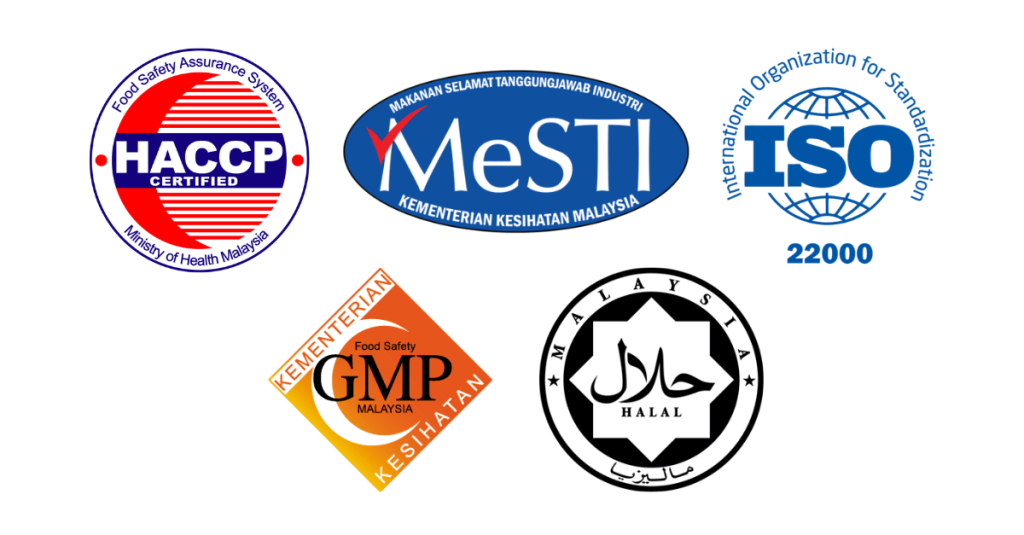
GMP Certification
GMP certification shows process control, not product quality on its own. It shows that a facility follows documented and controlled procedures for production and hygiene. However, it does not mean that your specific formulation is well-designed or suitable for its intended purpose.
JAKIM Halal Certification
JAKIM Halal certification is voluntary for many products, but it can be commercially important for brands targeting Muslim consumers in Malaysia and export markets. The Halal Malaysia Portal provides information on Halal certification requirements, validity, and renewal procedures.
HACCP and MeSTI
HACCP and MeSTI address food safety systems, but they do not determine formula ownership or exclusivity.
Ask for current, dated GMP and Halal certificate scans, not logos on a website, and a sample batch CoA to confirm a specific production run was actually tested. Our Quality Assured OEM Production process is built around this level of documentation.
|
Certification |
What It Covers |
What It Doesn’t Cover |
|
GMP |
Documented, controlled production and hygiene procedures |
Formula quality or ownership |
|
JAKIM Halal |
Halal status of ingredients and process |
Certification currency without a dated check |
|
HACCP / MeSTI |
Food safety hazard control and management systems |
Formula exclusivity or IP terms |
The 10-Question Evaluation Checklist

Ask any Malaysian OEM supplement manufacturer these ten questions before signing. Each question below is built around one of Protech’s five core differentiators: speed to market, end-to-end simplicity, formula exclusivity, in-house R&D, and Halal and export readiness.
That’s deliberate: these are the areas where a genuine OEM manufacturing partner should never hesitate to answer clearly.
Similar checklists exist for other manufacturing industries, including cosmetics OEM/ODM partnerships and general contract manufacturing, and the underlying evaluation discipline holds across industries.
Quality & Certifications
1. Is the OEM manufacturer GMP certified, and can they show you a current, dated certificate?
A dated GMP certificate proves the certification is current, not just historically true. This matters for long-term viability because an expired or scope-mismatched GMP certificate can block your NPRA product registration later, after you’ve already committed production budget.
2. How is shelf life determined for your product?
Shelf-life requirements vary by product type and formulation. For dried-form food supplements, a two-year shelf life is generally accepted. If formal stability testing is required, the brand owner may bear additional testing costs.
Ask the manufacturer how shelf life will be determined for your specific product and whether additional testing is necessary.
3. What quality control documentation ships with every production batch?
Batch-by-batch Certificate of Analysis (CoA) documentation, not just a one-off sample CoA, is what protects your supplement brand across the life of the manufacturing relationship. This CoA paper trail is what a regulator or an export buyer will ask for as proof.
|
Question |
Strong Answer |
Red Flag |
|
GMP certification |
Provides a dated certificate scan immediately |
Says “we’re certified” without offering documentation |
|
Shelf life |
Explains how shelf life is determined for your specific product |
Cannot clearly explain the basis for the stated shelf life |
|
QC documentation |
Confirms a CoA is issued with every batch |
Says CoAs are “available if needed” |
Protech’s approach: Our quality processes are backed by an in-house R&D team, part of our core formulation expertise.
Formulation & IP
4. Who owns the formulation once it’s developed?
Formula ownership is the single most important question in the whole checklist. Get the OEM or ODM ownership answer in writing, because it decides whether you can ever move to another manufacturer later without starting from zero.
5. What is their formula exclusivity policy, in writing?
A non-exclusive formula can end up, in similar form, on a competitor’s shelf. This exclusivity gap directly threatens the differentiation you’re paying your OEM manufacturer to build into your brand.
6. What non-disclosure agreement (NDA) protections are in place before you share your product concept?
Before sharing detailed formulation information, ask the OEM manufacturer whether an NDA can be put in place to protect confidential information. This is especially important before sharing specific ingredients, formulations, product specifications, or other commercially sensitive details.
|
Question |
Strong Answer |
Red Flag |
|
Formula ownership |
States clearly and in writing who owns the formula |
Vague answer, changes the subject |
|
Formula exclusivity |
Confirms in writing the formula won’t be reused for other clients |
Says exclusivity “depends” without specifics |
|
NDA terms |
Offers an NDA before detailed formulation discussion |
Only discusses NDAs if you raise it |
Protech’s approach: Formula exclusivity is one of our core differentiators: your formula is developed for and belongs to your brand under our OEM/ODM model.
Commercial Terms
7. How does MOQ flex by product format (capsule, powder, sachet, tablet)?
MOQ economics differ meaningfully by supplement format. An OEM manufacturer quoting one flat MOQ figure regardless of format may not have thought through your specific product.
8. How are pricing and lead time determined for your order?
Ask for a clear breakdown of pricing, minimum order requirements, and estimated lead time for your specific product. These can vary based on formulation, product format, packaging, and production requirements, so understanding them upfront helps you plan your budget and launch timeline more accurately.
|
Question |
Strong Answer |
Red Flag |
|
MOQ by format |
Explains specifically how MOQ differs across formats |
Quotes one flat MOQ regardless of format |
|
Pricing and lead time |
Clearly explains pricing, order requirements, and estimated lead time for your product |
Provides unclear pricing or timelines without explaining the relevant requirements |
Protech’s approach: Backed by our speed-to-market capability, with production as fast as 8 weeks.
Regulatory & Compliance
9. Will they actively support your NPRA registration and Halal certification?
A brand owner navigating NPRA registration or JAKIM Halal certification for the first time benefits from an OEM manufacturer with genuine hands-on experience with dossier preparation and certification requirements. Without this regulatory support, the compliance burden falls entirely on you, and delays here can push your launch back by months.
10. Can they provide the export documentation your target markets require?
Confirming export documentation upfront prevents you from discovering a documentation gap after an international buyer has already committed to an order. This export readiness matters for long-term viability the moment you plan to sell beyond Malaysia.
|
Question |
Strong Answer |
Red Flag |
|
NPRA and Halal support |
Describes their specific role in dossier prep or certification support |
Says “you’ll need to handle that yourself” |
|
Export documentation |
Names specific documents for specific markets |
General “yes we can export” without naming any |
Protech’s approach: Halal and export readiness is a core differentiator: our OEM Product Registration Services team supports both processes directly.
A manufacturer who answers most of these ten questions clearly, in writing, is worth taking seriously. Bring this checklist to a consultation with our OEM Health & Beauty Supplement team, and we’ll walk through every question directly.
Red Flags That Signal You Should Walk Away
The clearest red flag is a vague or evasive answer about who owns the formula. Refusal to provide dated certification copies or clear quality control documentation is close behind. A reputable manufacturer should be transparent about its certifications, testing processes, and production documentation.
Assuming a bigger, more recognisable factory is automatically safer is a common trap. Larger factories often carry higher MOQ floors and offer less flexibility for first orders than smaller or mid-sized manufacturers. Recognisability is not the same as fit for your specific product and order size.
The same evaluation checklist applies whether you’re building a human or pet supplement line. The regulatory route differs—DVS for many pet products versus NPRA for human supplements—but the underlying scrutiny on formula ownership and certifications does not.
For more on what pushes overall supplement brand costs up or down when budgeting your launch, see our cost breakdown for starting a supplement brand in Malaysia
Bring This Checklist to Your Consultation
You now have ten specific questions to bring to any Malaysian OEM manufacturer you’re evaluating. The most important one is still formula ownership: confirm in writing whether your OEM manufacturer or your ODM manufacturer holds the rights to your formulation before you sign anything else.
Bring the same checklist to a consultation with Protech Health Sciences, and we’ll walk through each one directly, whether you’re building a human or pet supplement line.
A rough product concept, target format, and an idea of target order volume are enough to start. You don’t need a finished formula to have this conversation. Learn more about how our OEM Product Development Services team works with new clients from concept through to production.
Contact us to share your product goals and bring this checklist to your consultation. If we’re not the right fit for your product, we’ll tell you honestly.
Turn Your Product Idea into Reality
From formulation to packaging and regulatory support, partner with
experienced OEM specialists to turn your product
idea into a market-ready brand.
Frequently Asked Questions (FAQs)
Often, yes, particularly for first orders on established formats. Ask what the price difference is at your requested MOQ versus the manufacturer's standard minimum, rather than assuming their first quote is fixed.
A MAL number is the product registration number issued by NPRA once a health supplement has completed registration, confirming it is legally approved for sale in Malaysia.
Not always. Printed packaging, such as films, canisters, or cartons, can carry its own minimum order quantity that's higher than the product's production MOQ.
A lab-scale pilot batch can help you assess product characteristics such as taste and overall formulation before committing to full production. Ask your manufacturer whether a pilot batch is appropriate for your specific product and development process.
No. Protech operates on an OEM/ODM model only, meaning your formula is developed specifically for your brand rather than selected from a pre-made catalogue.