
Switching your supplement OEM manufacturer in Malaysia is not a simple procurement change. It is an operational and regulatory transition that often takes weeks to months to complete and requires careful planning to avoid stockouts, compliance delays, and production disruptions.
This guide focuses on MAL-registered health supplements regulated by NPRA.
Successfully migrating your brand means managing NPRA change procedures involving the manufacturing site and/or Product Registration Holder, reviewing the Halal implications of a manufacturing change, and securing your formulation IP before notifying your outgoing supplier.
At Protech Health Sciences, we have guided scaling supplement brands through production migrations for over 20 years.
This guide outlines the key risks, contractual safeguards, and transition steps required to move your production cleanly and with less disruption.
Key Takeaways
- Build buffer stock first: Secure sufficient inventory before notifying your current OEM.
- Check your NPRA setup early: Confirm who controls the Product Registration Holder and Quest workflow before planning the move.
- Review Halal implications upfront: A manufacturing change can affect your Halal compliance pathway and supporting documentation.
- Protect your IP and tooling in contract: Make sure formulation ownership, tooling rights, and offboarding support are clearly stated.
- Not every switch is worth it: In some cases, fixing the current problem may cost less than changing OEMs.
Why Do Supplement Brands In Malaysia Stay With Underperforming OEMs For Too Long?
Most scaling supplement brand owners do not remain with an underperforming OEM supplier after fully weighing the alternatives.
They stay because leaving feels riskier than tolerating the problem.
The Sunk Cost Pitfall Of R&D Expenditure
A common rationalisation sounds like this: “We have already spent RM[X] on sample development, testing, and pilot runs. Starting over elsewhere wastes that investment.”
But that money is already spent. Staying with a weak OEM does not recover the cost. It extends it.
Tolerating an underperforming manufacturer comes at a cost: weaker margins, inconsistent batch quality, and growing brand risk.
If you have not yet mapped your full supplement brand cost structure, our guide to budgeting for a supplement brand in Malaysia covers every cost component before you commit capital.
Weaponised Inaction: How Poor-Performing OEMs Exploit Your Compliance Dependency
A supplement manufacturer that holds your NPRA Quest workflow, batch records, and active tooling is not just a production vendor.
It is also a compliance dependency, and some suppliers use that position to slow your exit.
This usually shows up in three ways:
- Silent price creeping: Unit cost increases framed as raw material adjustments
- Unannounced material downgrades: Packaging or ingredient substitutions presented as equivalent
- Production queue manipulation: Runs get deprioritised as your dependence grows
Recognising this pattern matters because the moment you decide to switch, the inventory-planning clock starts.
What Are The Real Costs Of Switching Supplement Manufacturers In Malaysia?
Switching supplement manufacturers in Malaysia usually creates four main risks: documentation gaps, NPRA change work, Halal compliance review, and inventory disruption.
These are the areas most often underestimated before the transition begins.
Formulation IP Transfer And Documentation Gaps
If your current OEM controls your formulation documents, switching becomes harder, slower, and more expensive.
When a brand owner does not have a complete Bill of Materials (BOM) when transitioning away from an existing supplier, there are generally two options: work with the outgoing supplier to obtain the necessary information, or have the new OEM reconstruct and redevelop the formula through its R&D process.
Protech Health Sciences’ product development and R&D team provides formulation development, ingredient profiling, and prototype testing to accurately match and reconstruct your product formulas.
Further reading: IP ownership rules differ depending on whether your current arrangement is OEM, ODM, or private label. Our OEM vs ODM comparison covers these distinctions in full.
The NPRA Registration Change Trap
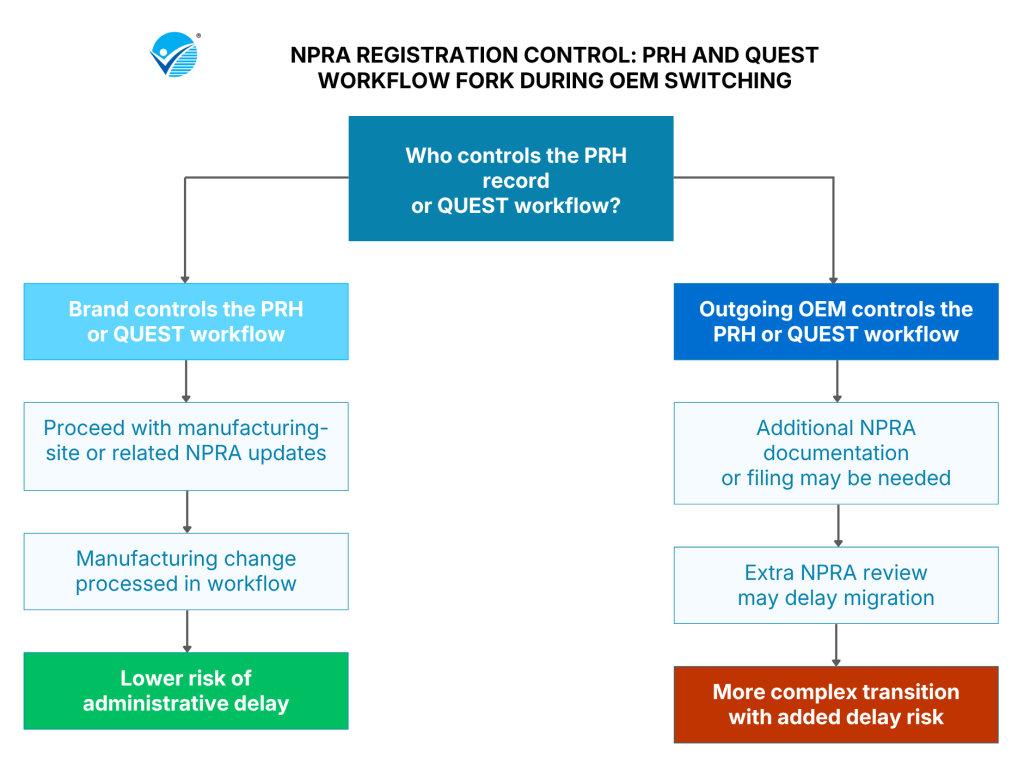
If your current OEM is listed as the Product Registration Holder (PRH) or controls the relevant NPRA QUEST workflow, your transition may not move cleanly to a new facility. In practice, the path often depends on who controls the PRH record and QUEST workflow.
Under the Control of Drugs and Cosmetics Regulations 1984, every registered health supplement in Malaysia carries a MAL number linked to the relevant product registration particulars in the NPRA QUEST system.
A manufacturing site or Product Registration Holder change may require NPRA documentation, a formal change application, or further clarification before production can move.
Important note: Check holder status and documentation responsibility early. Discovering this mid-transition can delay the entire migration.
Protech Health Sciences’ product registration support team manages this administrative transition as part of the production migration, helping brands reduce unnecessary delay.
The diagram below shows how the transition path may change depending on who controls the PRH record and QUEST workflow:
The JAKIM Halal Transition Process
A manufacturing change can affect your Halal compliance pathway. Depending on the existing certification structure and the new OEM arrangement, a fresh application, updated documentation, or further facility-level review may be required.
The new manufacturing arrangement should be checked against active JAKIM certification requirements, and your product may need further review under the new raw material supply chain.
The primary audit risk points during a Halal migration are often non-obvious:
- Capsule shell materials: Bovine, fish, and plant-based gelatin sources may carry different certification requirements
- Machinery lubricants: Non-compliant lubricants can create audit issues even if they are not consumer-facing ingredients
- Secondary ingredient supply chains: Gaps in the supply chain documentation can create Halal compliance concerns
For many supplement brands in Malaysia, Halal status affects both market access and buyer trust.
Protech Health Sciences’ Halal compliance infrastructure includes raw material supply-chain verification before first-run production.
Managing The Production Transition Gap
The biggest commercial risk in an OEM switch is running out of stock before the new production line is ready.
That is why inventory planning should begin before formal notice is given to the outgoing manufacturer.
Once a formal production migration begins, a brand owner should plan for a transition period that may run from several weeks to multiple months before the new OEM completes validation, pilot production, and first-run approval.
During the transition period, retail and distribution commitments still need to be fulfilled from existing inventory.
That is why the safety buffer should be built before formally notifying the outgoing OEM—not after.
Terminating the existing arrangement before securing sufficient buffer stock can increase the risk of retail stockouts and supply disruptions.
For context on how NPRA and production timelines stack up for a full supplement launch, see our guide to how long it takes to launch a supplement brand in Malaysia.
OEM Contract Transparency: Key Clauses for Brand Owners

When transitioning between manufacturers, a sound manufacturing agreement should provide complete operational and compliance clarity.
When negotiating with reputable, GMP-certified manufacturers like Protech Health, brand owners should establish standard transparency across these areas:
1. Formulation IP And BOM Transparency Rights
The custom formulation, active ingredient specifications, and master blending parameters belong to your brand, not the facility.
2. Physical Tooling And Custom Mould Extraction Rights
Custom tooling, stickpack dies and specialised moulds funded by your brand should have clear ownership and retrieval rights in the manufacturing agreement.
3. Notice Windows For Material Costs
Agreements should include structured notice periods (such as 30 to 90 days, depending on supply chain lead times) with documented market justification before raw material adjustments take effect.
4. Defined Defect And Variance Tolerances
Standardised quality thresholds, such as microbial limits, capsule fill weights, and humidity tolerances, to ensure batch-to-batch consistency under local operating conditions.
When Should You Not Switch Your Supplement OEM Supplier?
Not every production bottleneck warrants a supplier change. A full migration may not solve underlying problems in cases such as:
Minimum Order Quantity (MOQ) Misalignment
If current batch volumes do not meet an established facility’s operating scale, moving may not resolve scheduling delays.
Global Active Shortages
If an active, patented botanical extract or ingredient is facing a global supply shortage, changing manufacturers may not improve availability.
Core Formulation Instability
If a product exhibits chemical or physical breakdown due to fundamentally incompatible ingredients, the formula requires stabilisation rather than just a new production line.
Caveat: Protech Health Sciences will advise directly if a switch appears premature.
Reducing Risk Through Radical Transparency
Safe supplement manufacturer migration in Malaysia is a structured operational exercise, not an emotional response to a frustrating supplier.
The brands that execute it well usually do three things early: build an inventory buffer before signalling exit, secure their formulation and compliance records, and choose the next manufacturing partner based on transition capability rather than price alone.
Protech Health Sciences approaches each migration as a compliance and operational planning exercise.
Regulatory risks, formulation reconstruction requirements, NPRA change obligations, and Halal compliance requirements are mapped before the new contract is signed, helping brands maintain market supply while production transitions.
Contact Protech Health Sciences technical team today to schedule an OEM manufacturing consultation and compliance review.
Turn Your Product Idea into Reality
From formulation to packaging and regulatory support, partner with
experienced OEM specialists to turn your product
idea into a market-ready brand.
How To Evaluate A New Supplement OEM Manufacturer In Malaysia Before Committing
Before signing with a new OEM, run every prospective partner through the following checks:
GMP Certification Status And Supporting Documentation
Confirm that the facility holds valid GMP certification and request the latest supporting documentation, audit records or inspection evidence.
JAKIM Halal Facility Certification Validity
Check that the facility holds active JAKIM facility certification to support your intended manufacturing arrangement, not just product-level Halal claims
NPRA QUEST Account And Product Registration Track Record
Ask whether the OEM has experience handling Product Registration Holder or manufacturing site changes for existing brands.
Quality Control And Batch-Testing Protocols
Confirm that the manufacturer adheres to strict quality control protocols, routine in-process batch testing, and documented procedures for handling batch variances and Certificate of Analysis (CoA) verification.
Relevant Product Experience and Volume Range
Ask about the OEM’s experience with similar product categories and approximate production volume ranges.
End-To-End Transition Support Scope
Confirm whether the OEM manages NPRA change work, Halal compliance review, and packaging-line alignment as part of onboarding.
How To Switch Supplement Manufacturers Safely: A Phased Transition Framework
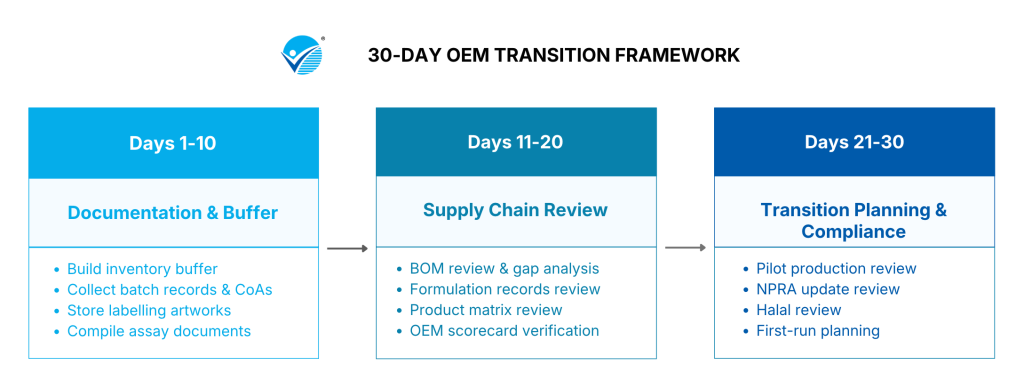
A structured OEM migration prioritises risk mitigation, regulatory compliance, and steady retail supply.
This 30-day sequence serves as a flexible framework from the decision to switch through to briefing and planning with the incoming OEM, with actual manufacturing and regulatory completion timing guided by technical readiness, stock positions, and regulatory requirements:
Days 1–10: Secure Documentation And Build Your Buffer
Start building your inventory buffer with your current manufacturer while production conditions remain normal and the relationship is stable.
At the same time, gather and independently store essential compliance files :
- Active batch records and Certificate of Analysis (CoA) documents
- Labelling artwork for all live SKUs
- Regulatory certificate copies, including NPRA and JAKIM documentation
- Ingredient assay files, especially for single-source materials
Completing this documentation review early lets an incoming OEM partner map technical gaps without causing supply disruptions.
Days 11–20: Review Supply Chain And Formulation Stability
During this phase, Protech Health Sciences reviews your Bill of Materials (BOM) to identify vulnerable or single-source supply-chain components.
Available prototype sample and stability testing records can be reviewed to evaluate formulation consistency and product shelf life under local storage conditions.
Confirm product compatibility requirements across your SKU range before scheduling commercial production.
Days 21–30: Pilot Production Validation And Regulatory Review
Pilot-scale production requirements are reviewed to prepare for verification of capsule fill weights, machine flowability, seal integrity, and packaging-line tolerances before full production approval.
At the same time, NPRA documentation and relevant Halal compliance documentation should be reviewed and prepared as applicable for the new manufacturing arrangement.
Pilot validation should not be rushed. Compressing this step often leads to batch, packaging, or quality issues that cost more to fix later.
Actual pilot production, regulatory processing, and first-run approval may continue beyond the first 30 days.
Turn Your Product Idea into Reality
From formulation to packaging and regulatory support, partner with
experienced OEM specialists to turn your product
idea into a market-ready brand.
Frequently Asked Questions (FAQs)
Protech establishes baseline quality benchmarks using your brand's historical finished-product specifications, ingredient profiles, and prototype testing data.
Our quality assurance team then follows strict in-process quality control protocols, routine batch-testing inspections, and Certificate of Analysis (CoA) verification starting with your first commercial batch.
If the outgoing OEM refuses to initiate a PRH transfer in the NPRA Quest system, the brand owner must submit a fresh product registration application under their own entity or their new manufacturing partner.
Protech’s regulatory team manages this by compiling a new registration dossier and stability profile for the new manufacturing arrangement, while your remaining stock continues to clear the market.
Existing stock already distributed into the retail channel remains saleable up to its approved shelf life, provided the batch records and original NPRA registration particulars remain compliant.
A manufacturing change applies to future production runs and does not automatically invalidate properly released batches already in the market.
Usually, no.
During the technical review, Protech’s engineering team assesses your existing packaging specifications, tooling and component dimensions to determine compatibility with our production lines. Any required tooling adjustments can be identified during the technical review or pilot testing, helping to minimise unnecessary changes to your existing packaging.
Protech Health Sciences supports scaling brands with flexible production planning, tiered MOQ options, and structured pilot validation steps to help manage upfront manufacturing capital during a supplier changeover.



One Response